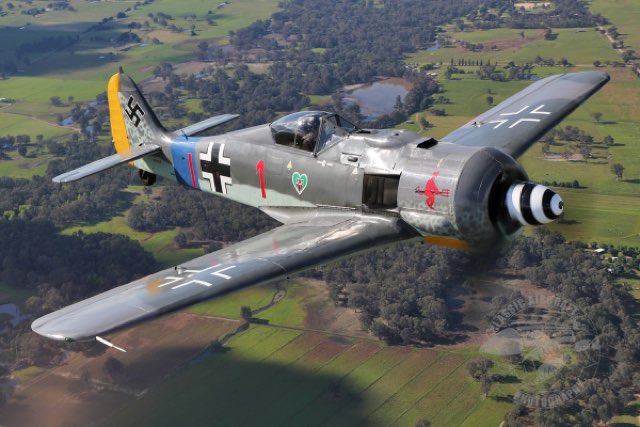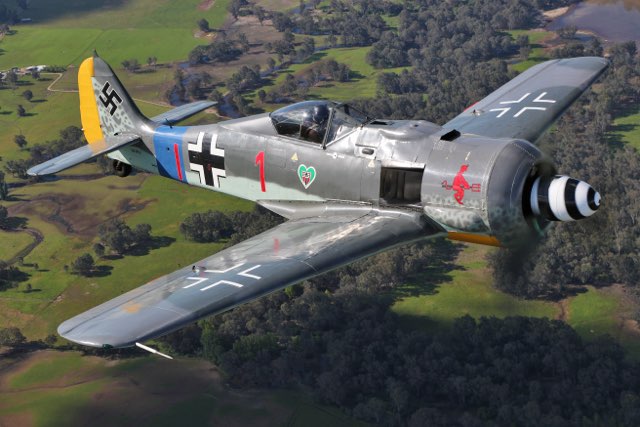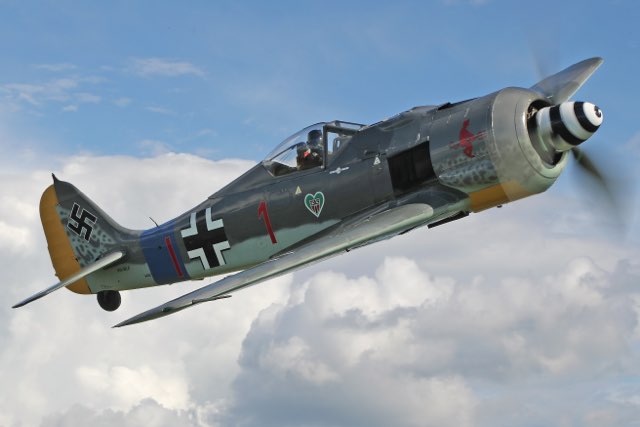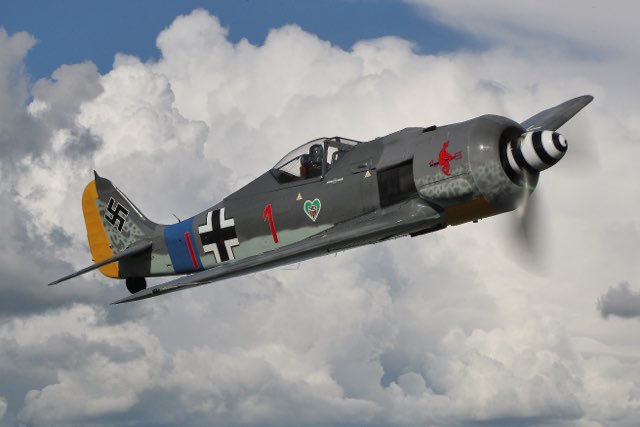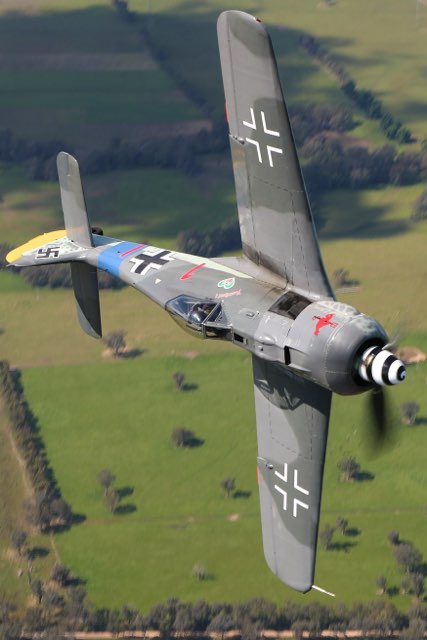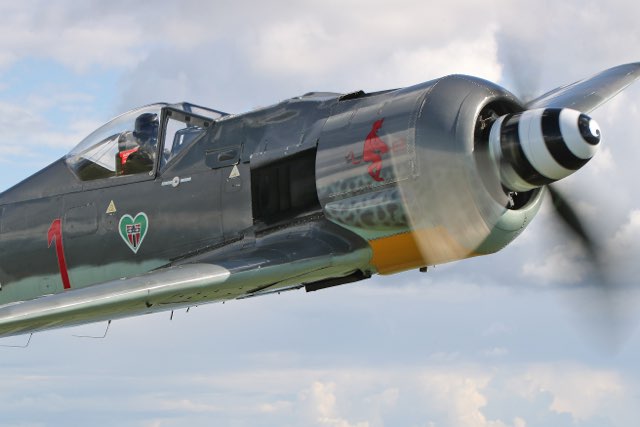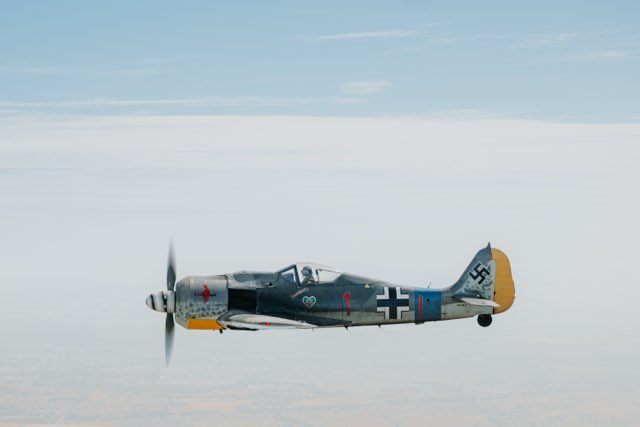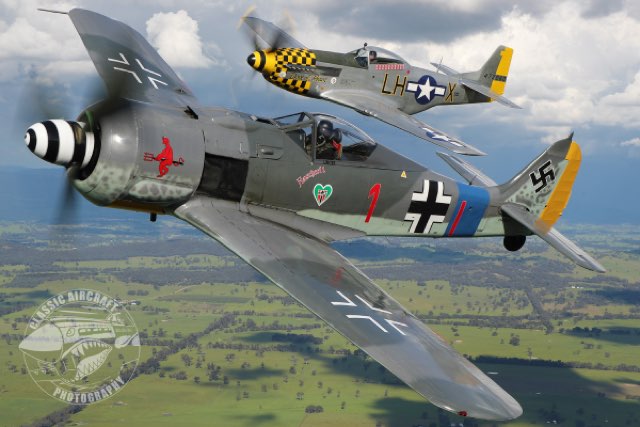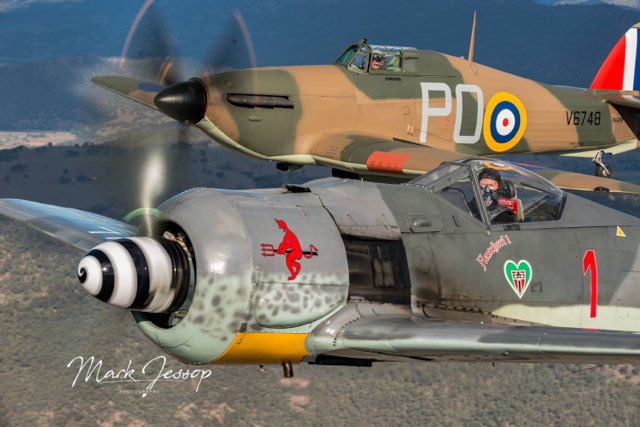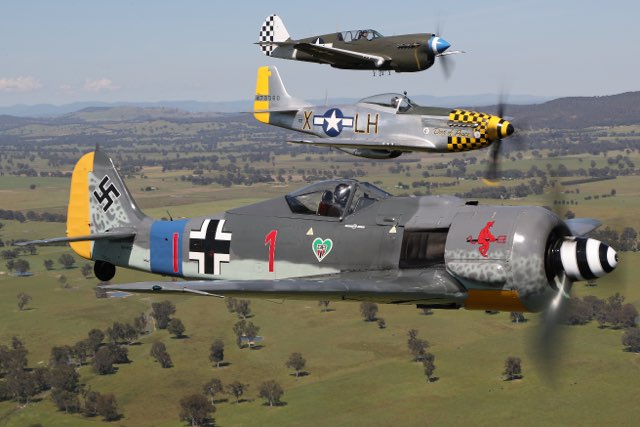
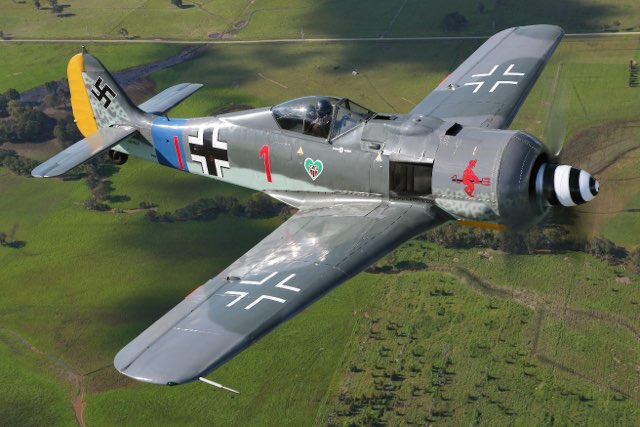
Focke-Wulf FW190
Price : £ POA
Aircraft Information
Type: FW 190 A8.
Total Time: 150 Hrs.
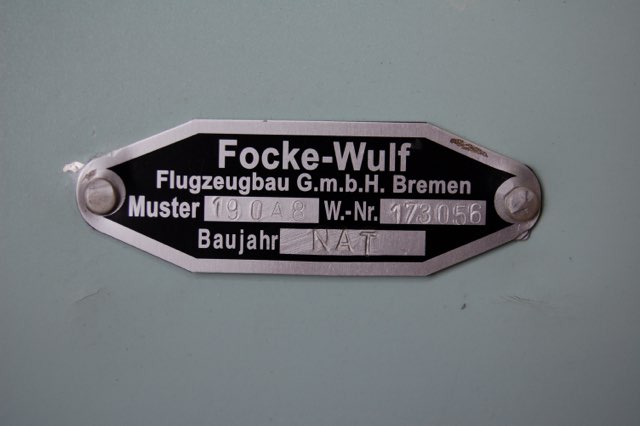
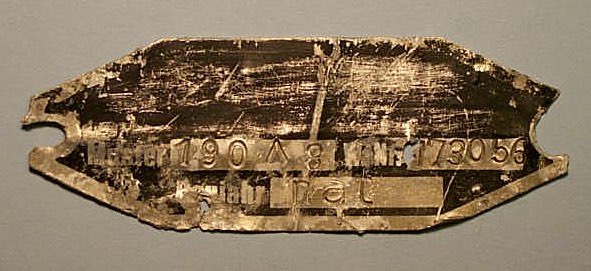
Serial number: 173056
Engine: Shvetsov ASh 82T with 1900 HP. TTSN: 150 Hrs
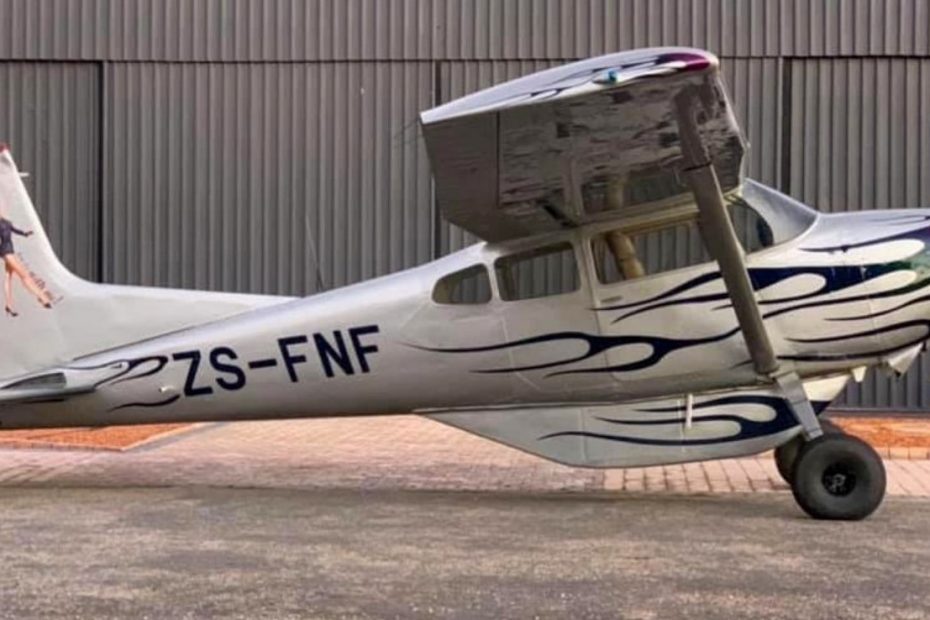
Civilian registration: VH-WLF
Call for Price
The Fw 190A-8 was one of the most important Luftwaffe fighters of the later war years, valued by pilots for its reliability, durability, and firepower. It was respected by Allied pilots as a tough opponent and earned the nickname “Butcher Bird”. More than 6,600 A-8 variants were produced before the war’s end.
Werk Numner 173056
Focke-Wulf 190-A8 werk nummer 173056 was manufactured in Cottbus, Germany in July 1944. The original data tag for the aircraft displays the letters “NAT” which suggest it was manufactured at the Focke-Wulf plant in Marienburg, Germany, however, this plant was destroyed in an air raid on the 9th of October 1943. It is believed several aircraft sub-assemblies including w/n 173056 were rescued from the Marienburg ruins and transported to Cottbus, Germany for final assembly. History suggests w/n 173056 joined Gruppe I of Jagdeschwader 11 (I./JG11) in late July/early August 1944 where it flew as “White 14”. Jagdgeschwader 11 was a German fighter wing operating under
Luftflotte 3 (Air Fleet 3) – one of the primary divisions of the German Luftwaffe in World War II. On August the 17th 1944, Luftflotte 3 was ordered to withdraw to Reims after concentrating most of its efforts on attempting to hamper Allied tanks pushing on towards Paris. By August the 30th 1944 Reims was liberated by allied ground forces and almost immediately, the United States Army Air Forces IX Engineer Command 850th Engineer Aviation Battalion cleared Reims airport of mines and destroyed Luftwaffe aircraft.
In 1989, w/n 173056 was retrieved from Reims with the intent of being restored in France. In 2001 the wreckage was purchased by an American collector, and in 2002 it was sold to Don Hansen of Louisiana USA, who tasked PAI Aero with the restoration project. Although some of 173056 was able to be salvaged from the twisted remains, PAI Aero relied heavily on Flug Werk for components. After ten and a half years, Fw 190A-8, w/n 173056, took to the air on October 9th, 2011. From 2011 to 2014, the aircraft completed its test flight regime at the hands of experienced test pilot Klaus Plasa.
The Fw 190 Reborn
In 1990 British motorsport engineer David Potter walked into a forgotten corner of the Imperial War Museum’s Duxford store and opened the first of eighty wooden tea chests. Inside lay the complete Focke-Wulf drawing archive captured from Bremen in 1945: 17 300 glass negatives, 10 000 prints, and 1 350 boxes of factory paperwork untouched since 1947.
Six years later, in 1996, German airline captain Claus Colling and businessman Hans-Günther Wildmoser founded Flug Werk GmbH in a Bavarian hangar with one ambition: to build the fighter again, exactly as the drawings demanded. They hired Arthur Bentley, a retired Hawker Siddeley draughtsman who had spent his life translating blueprints into metal, to stitch the archive together. Three-and-a-half tonnes of wartime wreckage were scanned, measured and digitised to fill every gap. Over eight years the team logged 34 000 man-hours, produced 8 000 fresh CAD drawings, forged 970 special tools and erected fifteen assembly jigs. On a bright July morning in 2004 the first Flug Werk Fw 190 lifted off, fifty-nine years after the last factory-fresh example had rolled out of Cottbus.
The Flug Werk FW190 is an exact restoration of the original aircraft. All the hardware for the aircraft conforms to the former German RLM (Reichsluftfahrtministerium or Ministry of Aviation) standards, even to the point where all countersunk riveting was done with specially made 120-degree countersunk rivets. The same company that provided the cyclo-type gearboxes for the retraction of the landing gear during WWII, supplied the same reduction drives for the new FW190. Even the electrically operated gear-uplocks were replicated down to the most minute item. The paint is made by the once original war-time paint manufacturer, Warnecke und Böhm, albeit with modern ingredients, now being epoxy/acryl-based enamels. This company invested a great amount of research and development in order to be able to supply all needed RLM colour-shades in the correct gloss and pigment-count. An original canopy was retrieved from the lake-bed of Lake Constance and was used to manufacture the plug for heat-forming the new acrylic canopy. Even the windshield has kept its original thickness of 50 mm. As with most warbird restorations the aircraft is missing its firearms and armour plating, thus saving approximately 450kg from the combat ready weight.
With the BMW 801 being essentially extinct, it was a major task to find a suitable engine for the airframe. The only worthy substitute was the Russian designed Shvetsov ASh 82 T engine. This powerplant is almost identical to the BMW in that it has the same weight, diameter, length, swept volume and is also direct fuel-injected. At 1900 HP it has about 200 HP more than the original BMW 801. All aspects of the engine-installation were precalculated and proven in theory, such as cooling airflow, the efficiency of the cooling-fan, oil-cooling and a stress-analysis of the newly designed engine mount, by a very skilled stress-analyst and a designer-engineer at the University of Munich’s aeronautical branch. A complete exhaust system needed to be designed, following the original BMW’s confinements and comprising of 14 individually formed exhaust stacks. A computer-animated wind-tunnel analysis was performed in order to define the position of the oil cooler, which is in the position of the two machine-guns just ahead of the windshield.
The three-bladed propeller was specially manufactured by MT-Propeller in Straubing, Germany. The blades are an exact copy of the wooden blades, destined for the Fw 190 A 10 – a “hopped up” version with the BMW 801 TJ engine of 2000 HP and thus closely matching the higher output of the ASh 82 engine.